Showing posts with label traditional publishing. Show all posts

Saturday, April 12, 2014

Preservation and Will The eBook Replace the Traditional Paperback?


Hi all,

After watching a program recently about eBooks and the effect they were having on the traditional publishing industry it got me thinking about some of the points they raised and how as a society we had grown to rely on our electronic gadgets.
Think back, it’s not that long ago we were all watching video tapes, well my generation was. I reckon if I go up in my loft I’m bound to find a box or two with a few old VHS films in it. I’ve even got some recordings of my children when they were much younger, I remember my wife pushing them through the park in their buggies. At the time, all of these recording devices were at their peak, high quality, something that we’d keep forever. Sadly I don’t think I have a VCR player in the house to watch them on now. No problem you say, you can get them converted to DVD. Yes you can, but with use, they say a DVD will last approximately five years, a Blue Ray, I imagine the same.

So what’s next on the electronic trail for saving data, it is after all only a collection of 1’s and 0’s but if a few of those binary numbers disappear, what happens?
Memory disks or sticks? Can you really trust them? Especially with those precious family photos. By the time our youngest daughter was born the first digital cameras were affordable to the general Joe’s like me. The camera was the size of a house brick and we took it everywhere. All of her baby photos were on it, they were downloaded and saved onto disks, and guess what, now we don’t have a PC with a disk reader – luckily we had them put onto a DVD.
Hard Drives, again only have a life of about eight years. So how do we keep our data safe, yeah today there are other ways to back files up, Dropbox, Cloud etc. But what if all of those 1’s and 0’s go wrong at what point do we risk losing it?

We sit back and put too much faith in our devices and the companies that supply them. I own a Kindle and I love it, I read loads of eBooks and to be honest I couldn’t see myself without it. But being a writer I do worry about the long term effect it could have on the industry as a whole, to the bookstores we all love to browse around, and for the new authors trying to break through, we have to ask. Will the eBook kill off the traditional?
 
Did you know when you purchase an eBook from Amazon you can never actually own it?
I only found this out myself recently, Google it, I did here’s one site from many I found Do You Ever Own You eBooks?
Apparently you are only buying the licence to read it, and if at some point Amazon decide to withdraw that book, whether it be for copy write reasons as they did in 2009 with George Orwell’s Animal Farm and 1984, or for some other reason they have in their Terms and Conditions small print, they will do so.

So to answer my own question – Will the eBook kill off traditional?
In the long run, I don’t think so. People will eventually get that they don’t actually own something they’ve paid for, yes they’ll be those that don’t care, but I do.
Electronic media is unreliable and is prone to breaking down, it can be easily damaged and data can be too easily lost. And on the other side of it, can we keep up? The advances in technology are being thrown at us so fast nowadays that today’s latest technological releases are all too soon yesterday’s news.

In the title of this piece, I mentioned the word Preservation. Our whole history revolves around this word, and most of it has been by either hand or the printed letter. Could we really have trusted the history of humankind to be documented all along electronically, how long would it have been until a few 1’s and 0’s disappeared?


Manuscript on vellum, illuminated by the Masters of the Zwolle Bible and the Masters of Margriet Uutenham. Netherlands, Arnhem and Zwolle, c. 1470.
c1470 Looks as if it could have been printed yesterday.


I will leave you with a fitting quote on the subject…
“Books are no more threatened by Kindle than stairs by elevators.” – Stephen Fry


All the best,
Daniel Kaye x


Sunday, March 23, 2014

Applying for your ITIN - US Individual Taxpayer Identification Number


Hi all, 


Over the last few years I’ve been fortunate enough to have my short stories published in various anthologies in both Ireland and the US, including my own collection, The Eleventh Hour. But as some of these anthologies were compiled for the love of writing I didn’t give much thought to the financial side of matters. Back in 2013 circumstances changed when Gentry Publishing, New York, offered me a contract for my first novel I, Vladimir.


So my journey began and in doing so I had to learn what an ITIN was, and obtain one from the United States Internal Revenue Service. Being a non-residential, non-US citizen, the thought of the IRS brought cold sweats and it was one of those tasks I was quite willing to put off. By August it was time to bite the bullet and get it done.

An ITIN stands for Individual Taxpayer Identification Number. It is a United States tax processing number issued by the Internal Revenue Service for non-residential, non-US citizens, who are either employed or will be paid by a company registered in the United States.
If you are publishing through a US company, whether Traditional, Indie, or any of the self-publishing services, it would be in your best interest to obtain an ITIN. The reason being is by law, all companies have to withhold a percentage of your royalties for tax purposes (30%), and you could then also be liable for tax within your own country too. By registering with the IRS and obtaining an ITIN you become tax exempt in the United States as long as your citizenship and residential status remains unchanged.
Reading up on how to get an ITIN seemed very daunting, hence another reason I kept putting it off, but in the end I found it a lot more straight forward than I’d first imagined – so I’ll try and keep it simple…

Firstly – Letter.
You will need a signed headed letter from your publisher or agent stating that you have a contract with them. If you are self-publishing, Amazon have one on their site which you download and print off.   Here.


Secondly - Passport.

Ireland has an agreement with the US where you do not have to post your passport, all you need is a letter of authentication from your passport office. You take your passport along to your local passport office, for a charge (€40 approx) they photocopy it and hand you back the photocopy and a stamped letter confirming all the details are correct and that you are indeed whom you claim to be. If you are not an Irish citizen, check with your own passport office to see if there is an agreement in place, otherwise I think you have no option but to send your passport. But I have to say that all documents were returned to me safely.


Thirdly – Application Forms.
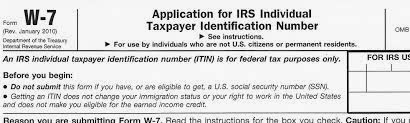
You can download the forms directly from the IRS website. There are two to look at, the first which I strongly recommend you read in full is the instruction guide 

 Instrustions For Form W - 7  and the second is the application itself Application Form W - 7 which to be honest is pretty straight forward. Like with all forms, just read through it carefully and take your time.


When you have all documents, do not send in part or incomplete, send by post to:

Department of Treasury,
Internal Revenue Service,
PO Box 149342
Austin, TX 78714-9342
United States of America. 

At the time of writing this all the information given was correct and what I personally had used. I obtained my ITIN on my first attempt, I have read of others that have taken three or more goes.
All I can say is take your time and make sure you have all the necessary documents and have filled everything in.


May I wish you all the best in your writing career and in your application for your ITIN,


Daniel Kaye x